WEIGHT LOSS & FITNESS BLOG
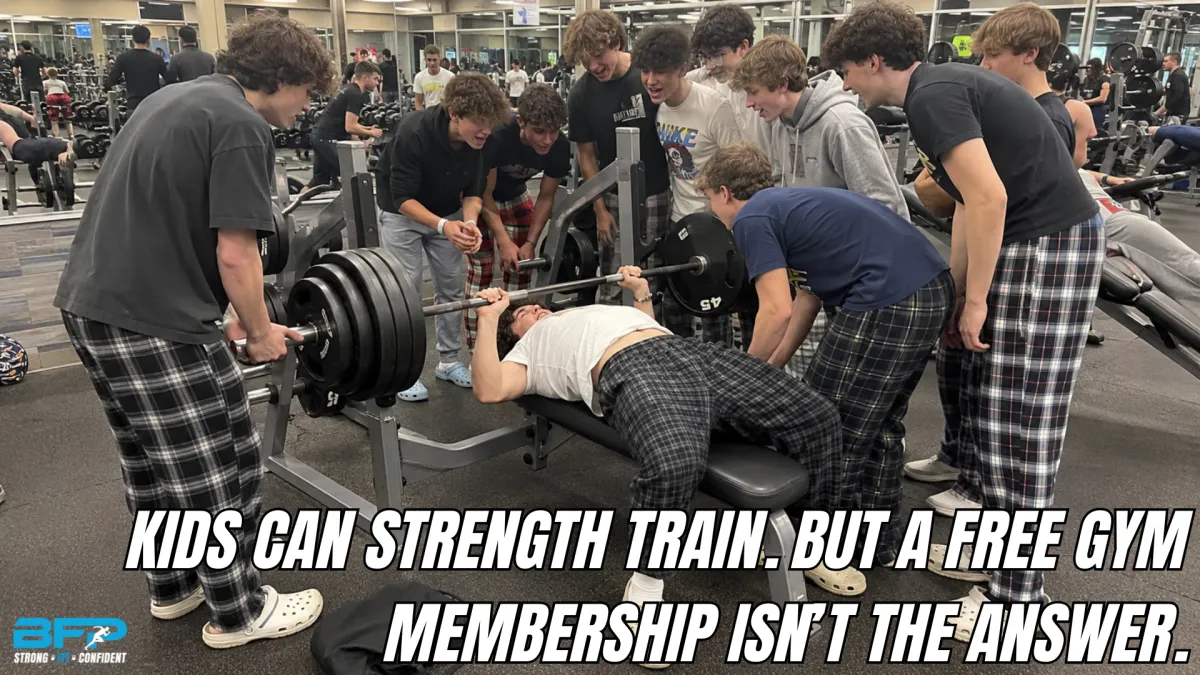
Kids Can Strength Train. But A Free Gym Membership Isn’t The Answer.
Kids Can Strength Train. But A Free Gym Membership Isn’t The Answer.
A free gym membership sounds like a great thing for a teenager.
They get access to equipment. They get a place to work out. They get a chance to build strength, confidence, and healthy habits.
And honestly, that can be a good thing for the right kid in the right environment. But access to equipment and actual coaching are not the same thing.
Kids can absolutely benefit from strength training. The research supports it. As coaches, see it every day. Parents see it when their kids move better, get stronger, carry themselves differently, and start feeling more confident. But youth training needs structure. It needs supervision. It needs someone teaching movement, correcting technique, progressing things appropriately, and helping kids understand what they’re doing and why.
A free membership gives a kid access.
Coaching gives them direction.
That’s the difference.
The Real Question Isn’t “Can Kids Lift?”
A lot of parents want their kids to get stronger, faster, more confident, and more athletic. That makes sense. Sports are competitive. Kids are playing more often. The demands are higher. Even kids who aren’t chasing college scholarships still benefit from being stronger, more coordinated, and more confident in their bodies.
But when strength training comes up, parents can get nervous. They wonder if it’s safe. They wonder if their child is too young. They wonder if lifting weights will hurt them.
Those are fair questions.
But the better question usually isn’t, “Should kids strength train?” The better question is, “What kind of strength training are we talking about?”
Because there’s a big difference between a coached youth training program and a kid walking into a gym with no plan, no movement screen, no instruction, and no real understanding of how to train. One teaches. The other assumes the kid already knows what to do.
That’s a big assumption.
What We See With Kids
At BFP, we’ve coached a lot of kids over the years. Some are naturally athletic and comfortable moving. Some are strong but awkward. Some are fast but can’t slow down well. Some play sports year-round but have never been taught how to squat, hinge, land, brace, carry, or change direction with control.
That’s not a knock on them. That’s just youth development.
Kids are still learning how to use their bodies. They’re growing. Their coordination is changing. Their confidence is developing. Their attention span is different from an adult’s. Their training age is usually low, even if they’ve played sports for years.
That’s why coaching matters.
A kid might play soccer five days a week and still need to learn how to land and decelerate. A baseball player might throw all season and still need better trunk control, shoulder strength, and lower-body strength. A volleyball player might jump constantly and still need to learn how to absorb force when they land.
Sport practice and strength training aren’t the same thing.
Sport practice develops skill for the sport. Strength training helps build the body that supports the sport. Both matter, but they aren’t interchangeable.
Why A Free Membership Usually Isn’t Enough
There’s nothing wrong with an open gym model for the right person. Some folks know what they’re doing. They have a plan. They understand technique. They know how to progress. They know when to push and when to back off.
Most kids aren’t there yet.
Without coaching, a lot of kids default to whatever looks fun, whatever their friend is doing, or whatever they saw online. That usually means they spend too much time on the stuff they’re comfortable with and not enough time on the things they actually need.
They may rush through movements. They may load too heavy too soon. They may avoid exercises that feel awkward. They may turn training into messing around because nobody has taught them how to treat the gym like a place to train.
Again, that doesn’t make them bad kids.
It makes them kids.
A free membership may give them opportunity, but opportunity without guidance doesn’t always turn into results. In some cases, it turns into frustration. In other cases, it turns into bad habits that have to be cleaned up later.
Good youth training isn’t just access to equipment. It’s coaching, correction, structure, and progression.
What Good Youth Training Should Look Like
Good youth training usually looks simple from the outside because the basics matter most.
Kids need to learn how to squat, hinge, push, pull, carry, jump, land, accelerate, decelerate, brace, and change direction. They need to learn how to control their body before they’re asked to do more advanced things. They need to understand effort, but they also need to understand technique.
A good program should meet the kid where they are. Some kids need strength. Some need coordination. Some need confidence. Some need better mechanics. Some need to slow down and learn control before they worry about speed or power.
Parents also need to know this: training doesn’t have to crush kids to be effective. A kid doesn’t need to leave every session destroyed. They don’t need to be sore for three days. They don’t need to train like a college athlete before they’re ready.
They need consistent coaching, appropriate progressions, and an environment where effort and technique both matter.
That’s how you build something that lasts.
What The Research Says
The research on youth resistance training has come a long way. The old fear that properly supervised strength training is automatically dangerous for kids isn’t supported by the modern literature.
The National Strength and Conditioning Association’s position statement on youth resistance training concluded that a properly designed and supervised resistance training program can be safe and effective for children and adolescents. The key phrase is “properly designed and supervised.” That matters. The issue usually isn’t strength training itself. The issue is poor coaching, poor technique, inappropriate loading, and programs that don’t match the child’s age, ability, or training history.
A 2014 international consensus statement published in the British Journal of Sports Medicine made a similar point. It supported youth resistance training when it’s properly supervised, age-appropriate, and focused on movement competency, strength, injury reduction, and long-term athletic development.
A systematic review and meta-analysis by Lesinski and colleagues looked at resistance training in youth athletes and found that resistance training can improve several areas of physical performance, including muscular strength, jumping, sprinting, and change-of-direction ability. That doesn’t mean every kid needs the same program. It means strength training can be a useful tool when it’s applied well.
Research on integrative neuromuscular training also supports the idea that kids benefit from learning strength, balance, coordination, agility, and movement control. Myer and colleagues have written about starting this kind of training early enough to build better movement patterns and potentially reduce injury risk as youth athletes grow and sports demands increase.
The simple version is this: kids can train. But the quality of the environment matters.
Where Parents Can Get Tripped Up
One mistake parents make is waiting until there’s already a problem.
They wait until the kid is hurt, frustrated, lacking confidence, or physically behind. Sometimes they wait until high school, when the sport gets more serious and the demands jump quickly.
I’m not saying every 11-year-old needs an intense strength program. That’s not the point.
But kids can benefit from learning how to train earlier than most people think. For younger kids, that may look like bodyweight control, jumping and landing, crawling, carrying, balance, coordination, light resistance, and learning how to follow coaching cues. As they mature, the training can progress with more load, more structure, and more complexity.
The foundation comes first.
A lot of folks want speed, power, and performance, but they skip the base that supports those things. Then they wonder why the kid struggles when the demands go up.
Bringing It Back To BFP
At BFP, our youth training isn’t built around handing kids access to equipment and hoping they figure it out.
It’s built around coaching.
We want kids to move better, get stronger, build confidence, and learn how to train the right way. That means we care about how they squat, how they land, how they hinge, how they carry, and whether they can control their body. We care about effort, but we also care about focus, listening, and doing things well.
We also care about the long game.
Some kids will play sports in high school. Some may play in college. Some may not play sports at all. Some just need a place where they can get stronger, build confidence, and learn that fitness can be part of a healthy life.
All of that matters.
We’ve had kids start with us in summer camps, move into youth training, and eventually grow into our adult program. That’s the kind of thing we love to see because it means training became part of their life, not just something they did for one season.
Yes, we want kids to perform better. Yes, we want them to be stronger. Yes, we want them to be prepared for their sport.
But more than that, we want them to build habits, confidence, and a better relationship with training.
That doesn’t happen by accident.
It happens through coaching.
The Practical Takeaway
Kids can strength train.
But a free gym membership isn’t the same thing as a youth training program.
A good program gives them coaching, structure, progression, correction, and a place where they can learn how to train the right way. If your child plays sports, that kind of training can support their development. If your child doesn’t play sports, it can still help them build confidence, coordination, and healthy habits.
The goal isn’t to rush kids.
The goal is to prepare them.
And when it’s done well, youth training can be one of the best things a kid does for their body, confidence, and long-term health.
References
Faigenbaum, A. D., Kraemer, W. J., Blimkie, C. J. R., Jeffreys, I., Micheli, L. J., Nitka, M., & Rowland, T. W. (2009). Youth resistance training: Updated position statement paper from the National Strength and Conditioning Association. Journal of Strength and Conditioning Research, 23(5 Suppl), S60–S79. doi:10.1519/JSC.0b013e31819df407
Lloyd, R. S., Faigenbaum, A. D., Stone, M. H., Oliver, J. L., Jeffreys, I., Moody, J. A., Brewer, C., Pierce, K. C., McCambridge, T. M., Howard, R., Herrington, L., Hainline, B., Micheli, L. J., Jaques, R., Kraemer, W. J., McBride, M. G., Best, T. M., Chu, D. A., Alvar, B. A., & Myer, G. D. (2014). Position statement on youth resistance training: The 2014 International Consensus. British Journal of Sports Medicine, 48(7), 498–505. doi:10.1136/bjsports-2013-092952
Lesinski, M., Prieske, O., & Granacher, U. (2016). Effects and dose-response relationships of resistance training on physical performance in youth athletes: A systematic review and meta-analysis. British Journal of Sports Medicine, 50(13), 781–795. doi:10.1136/bjsports-2015-095497
Myer, G. D., Faigenbaum, A. D., Ford, K. R., Best, T. M., Bergeron, M. F., & Hewett, T. E. (2011). When to initiate integrative neuromuscular training to reduce sports-related injuries in youth? Current Sports Medicine Reports, 10(3), 155–166. doi:10.1249/JSR.0b013e31821b1442