
WEIGHT LOSS & FITNESS BLOG
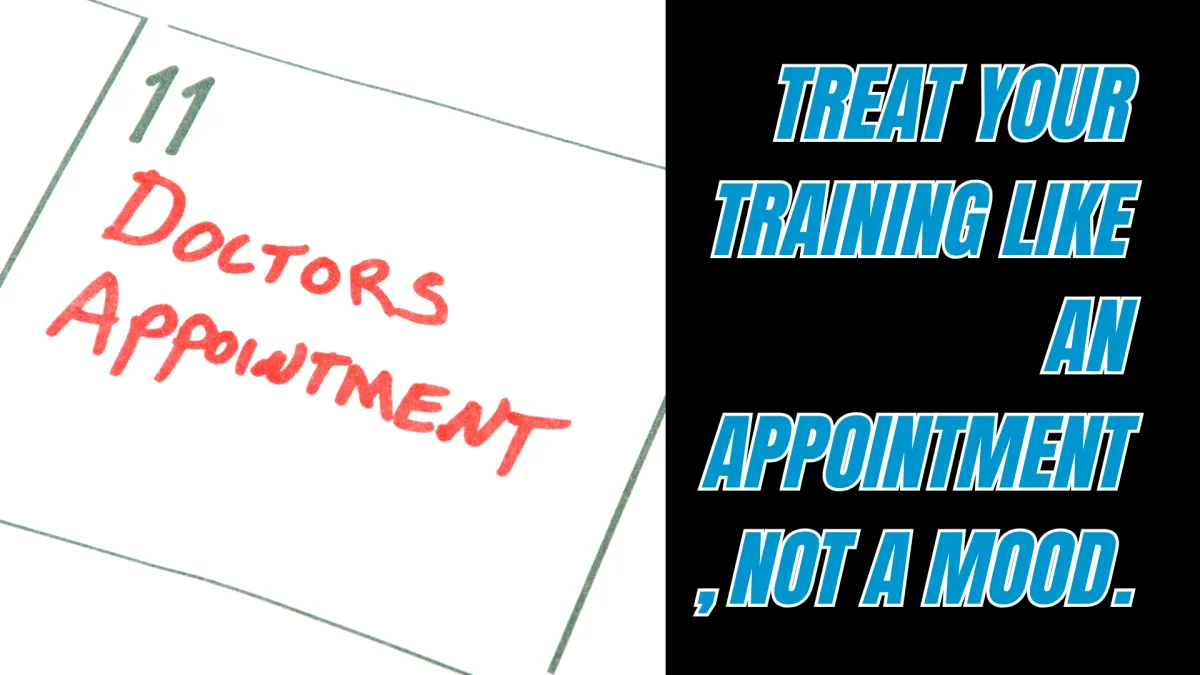
Treat Your Training Like An Appointment, Not A Mood
Treat Your Training Like An Appointment, Not A Mood
Most people do not need a more complicated workout plan.
They need a better relationship with their calendar.
That might sound too simple, but it is where a lot of people get stuck. They wait until they feel motivated. They wait until the week calms down. They wait until work slows down, the kids’ schedule opens up, the house is less chaotic, or they finally feel like they have the energy to get started.
The problem is that life does not usually calm down for very long.
There is always another practice. Another deadline. Another appointment. Another family thing. Another bill. Another reason why today is not the perfect day to train.
So if your fitness plan depends on the perfect day, it is probably not going to last.
That is why training needs to be treated more like an appointment and less like a mood.
Do You Say One Thing While Operating The Opposite?
A lot of folks say they want to be healthier, stronger, leaner, more energetic, or more consistent. And I believe them. Most people are not lying when they say they want those things.
But here is the problem: wanting something does not automatically give it a place in your life.
That is where people get frustrated. They think the issue is motivation. They think they need to feel more fired up. They think they need a harder challenge, a stricter diet, a better workout, or some big emotional moment that finally makes everything click.
Sometimes that happens.
Most of the time, it doesn't.
Most of the time, consistency comes from structure. It comes from deciding ahead of time when you are going to train, where you are going to train, and who is helping you stay with it when life gets busy.
That does not mean the gym becomes your whole personality. It does not mean you need to train every day. It does not mean you never miss a workout.
It means your health cannot always be the first thing that gets moved when the calendar gets full. Read that again. It doesn't have to be the last thing to move, but it can't always be the first.
Doctor appointments stay on the calendar. Work meetings stay on the calendar. Kids’ games stay on the calendar. Hair appointments, dentist appointments, school events, and family commitments all get treated like real things.
But training often gets treated like, “I’ll see how I feel.”
That is not a plan.
A Story That Stuck With Me
Recently, I was talking with a client. We will call her Sally for the purposes of this story. She trains with us and does nutrition coaching with us. She told me that her husband made a comment about her coming to the gym like it was something she just did for fun.
She corrected him.
She told him it was more like going to the doctor.
That stuck with me.
Not because fitness has to be dramatic. Not because every adult needs to become obsessed with the gym. Not because training should take over your life.
But because Sally had real reasons.
She has osteoporosis. She has grandkids. She wants to be strong. She wants to be capable. She wants to keep doing life well. Training is not just a hobby for her. It is part of taking care of herself.
That is a different mindset.
And honestly, I think a lot more people need that mindset.
We have watered fitness down into something people think they are supposed to do only when they are motivated, when they have extra time, or when they feel bad enough about themselves to start over again.
That is backwards.
Training should not be punishment. Nutrition should not be punishment. Taking care of yourself should not require you to hate your body first.
It should be part of how you live.
Sally’s point was simple: this matters enough to be on the calendar.
That is the shift.
What People Usually Get Wrong
A lot of people think consistency means being perfect.
It does not.
Consistency means you have a system that helps you keep showing up even when the week is not ideal.
That might mean training two or three times per week instead of five. It might mean modifying the workout because your knee is irritated. It might mean walking instead of running. It might mean doing the best version of the plan that fits your life right now.
But it still means showing up.
This is where people get caught in the all-or-nothing trap. They miss one workout and feel like the week is ruined. They eat one off-plan meal and act like the whole nutrition plan is gone. They have one busy season and convince themselves they need to start over later.
That mindset keeps people stuck.
The better approach is to build a repeatable rhythm. Not a perfect one. A repeatable one.
For most adults, that means having a few things locked in:
A set training schedule
A realistic nutrition focus
A coach or community expecting them
A plan that adjusts when life gets messy
A way to come back quickly when they miss
That is not flashy, but it works.
The truth is, most people do not need more fitness noise. They do not need another random workout saved on Instagram. They do not need a stricter plan they can only follow for twelve days. They do not need to blow everything up and start from scratch every Monday.
They need structure.
They need fewer decisions.
They need a plan they can follow before the week gets chaotic.
What The Research Says
The research backs up what we as coaches see in real life: knowing what to do is not the same as doing it consistently.
The Physical Activity Guidelines for Americans recommend that adults get 150 to 300 minutes of moderate-intensity aerobic activity per week, or 75 to 150 minutes of vigorous-intensity aerobic activity, along with muscle-strengthening activity for all major muscle groups at least two days per week. That gives us a clear target, but it does not automatically solve the real-life problem.
Most adults already know they should move more.
Most adults already know strength training matters.
Most adults already know nutrition matters.
The hard part is not always knowing. The hard part is doing it consistently in the middle of work, kids, stress, travel, family, aging parents, injuries, and normal adult life.
That is where behavior change research becomes useful.
In a meta-regression published in Health Psychology, Michie and colleagues looked at healthy eating and physical activity interventions and found that behavior change techniques such as self-monitoring, goal-setting, feedback, and planning were associated with better outcomes. In plain English, people tend to do better when they have structure and support, not just information.
That matters because “I need to work out more” is not a plan.
“I train Monday, Wednesday, and Friday at 8:00, and there is a coach waiting for me” is much closer to a plan.
Even better "I check in with my nutrition coach daily on top of training MWF at 8am with a coach." Accountability the other 23 hours of the day matters too.
Other research has looked at the gap between intention and action. Sniehotta, Scholz, and Schwarzer studied exercise adoption and maintenance and found that planning, self-efficacy, and action control help people bridge the gap between wanting to exercise and actually following through.
That is the exact gap most people live in.
They intend to train. They intend to eat better. They intend to get back on track. They intend to prioritize their health.
But intention is not enough. Intention needs a schedule. It needs a plan. It needs follow-through. It needs support when the first stressful week hits.
A systematic review and meta-analysis in BMJ also looked at exercise referral schemes in primary care. One of the useful takeaways is that simply telling people to exercise is not the same thing as helping them become consistent. Advice matters, but adherence is the real battle.
That is why coaching matters. Not because people need to be yelled at. Not because they need shame. Not because they need someone acting like a drill sergeant.
They need support, accountability, adjustment, and a plan that fits real life. Someone reminding them of how far they've come when things feel stagnant. (I have a coach for this in my business too)
We Are Built For This
This is a big part of why BFP is set up the way it is.
We are not an open gym where people wander around trying to figure out what machine to use next. We are not a place where you need to show up with your own workout, your own plan, and enough confidence to coach yourself.
We are a coaching gym.
That means when you show up, the plan is already there. The coach is there. The session has a purpose. The movements can be adjusted. The environment is built to help you be consistent.
For a lot of busy folks, that is the missing piece. They do not need more decisions.
They need to know:
When am I training? What am I doing? Who is helping me? How do I adjust when something hurts?
How do I stay consistent when life gets busy?
How do I come back when I miss?
That is what coaching provides.
And that is why treating your training like an appointment matters. It takes the decision out of the mood of the day.
You don't wake up and ask, “Do I feel like going to the dentist today?”
You go because it is on the calendar and because you know it matters.
Training needs some of that same respect.
Again, not obsession. Not extremes. Not making the gym your whole life.
Just enough priority to stop starting over.
The Practical Takeaway
If you are struggling to stay consistent, don't start by looking for the hardest plan. Don't even look for a plan to start with.
Start by looking at your calendar.
Pick two or three days you can realistically train. Put them on the calendar. Treat them like real appointments. Then build from there.
And when life gets messy, don't disappear. Adjust.
That is what we help people do at BFP.
You show up.
We coach.
The plan is ready.
And over time, that simple rhythm can change a lot.
References
Piercy, K. L., Troiano, R. P., Ballard, R. M., Carlson, S. A., Fulton, J. E., Galuska, D. A., George, S. M., & Olson, R. D. (2018). The Physical Activity Guidelines for Americans. JAMA, 320(19), 2020–2028. doi:10.1001/jama.2018.14854
Michie, S., Abraham, C., Whittington, C., McAteer, J., & Gupta, S. (2009). Effective techniques in healthy eating and physical activity interventions: A meta-regression. Health Psychology, 28(6), 690–701. doi:10.1037/a0016136
Sniehotta, F. F., Scholz, U., & Schwarzer, R. (2005). Bridging the intention–behaviour gap: Planning, self-efficacy, and action control in the adoption and maintenance of physical exercise. Psychology & Health, 20(2), 143–160. doi:10.1080/08870440512331317670
Pavey, T. G., Taylor, A. H., Fox, K. R., Hillsdon, M., Anokye, N., Campbell, J. L., Foster, C., Green, C., Moxham, T., Mutrie, N., Searle, J., Trueman, P., & Taylor, R. S. (2011). Effect of exercise referral schemes in primary care on physical activity and improving health outcomes: Systematic review and meta-analysis. BMJ, 343, d6462. doi:10.1136/bmj.d6462


Are you Ready to become
sTRONG - FIT - cONFIDENT?
Click the Button To Start Your Journey Today!!


