
WEIGHT LOSS & FITNESS BLOG
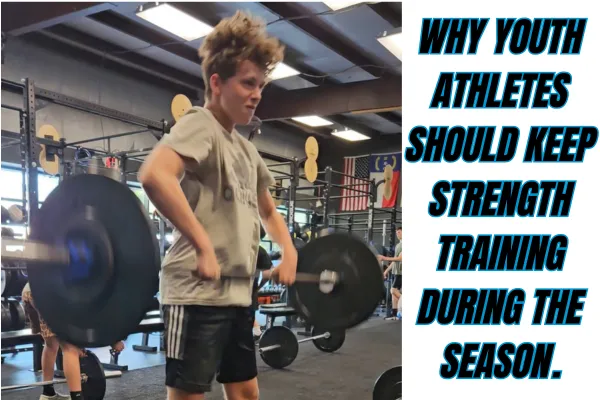
Why Youth Athletes Should Keep Strength Training During the Season
When the season begins, strength training is often the first thing removed from a young athlete’s schedule. Practices increase. Games take over the weekends. Homework gets heavier. Parents worry that lifting will make the athlete tired, sore or less prepared to compete.
The answer is not to train through every sign of fatigue or force a full off-season workload into a crowded week. The answer is to adjust the dose. In-season training should look different from off-season training, but completely removing strength and neuromuscular work can allow useful physical qualities to fade while the athlete continues to absorb the demands of practices and games.
The research does not support a dramatic claim that an athlete who stops lifting will automatically get hurt. Injury is more complicated than that. Previous injury, total workload, sport demands, sleep, growth, conditioning and many other factors play a role. What the evidence does show is that strength and neuromuscular training can reduce injury rates and improve important physical qualities when athletes continue to perform it consistently.
The season does not maintain every quality automatically
Playing a sport improves sport skill and exposes the athlete to the movements required in competition. It does not guarantee that strength, power, landing mechanics, deceleration ability and tissue capacity will all remain at the level developed during the off-season.
In many sports, practice time is mostly spent on tactics, position work, scrimmaging and team preparation. Coaches have limited time. An athlete may sprint, jump and change direction, but exposure alone is not the same as a progressive strength program. The athlete can become highly practiced at the sport while still losing some of the physical foundation that helps support those actions.
A systematic review of injury-prevention strategies in adolescent sport concluded that preseason conditioning, balance, functional training and sport-specific injury-prevention work were effective when continued through the competitive season. A more recent systematic review and meta-analysis of strength-based injury-prevention programs found lower injury rates when athletes adhered to programs that included strength training. The key word is adherence. A program that disappears once games begin cannot provide an ongoing training effect.
In-season strength training should be smaller and more precise
The off-season is usually the best time to build. The in-season goal is often to maintain strength, address the athlete’s needs and keep enough high-quality exposure to prevent a long slide backward. That may require less volume than parents expect.
- One or two strength sessions per week may be enough for many youth athletes during the season.
- Sets can be reduced while the athlete continues to use meaningful resistance with good technique.
- Exercises should be selected around the sport schedule, soreness and previous injuries.
- Hard lower-body training should not be placed carelessly before an important game.
- Speed and power work should remain high quality, with enough rest to avoid turning every session into conditioning.
- The plan should change during tournament weeks, travel weeks and periods with several games.
The goal is not to prove how much work the athlete can survive. The goal is to provide the smallest useful dose that maintains or improves the qualities the sport depends on. The athlete should finish most in-season sessions feeling prepared to practice and compete, not as though another game was added to the week.
Strength work can support injury resilience
No training program can make a young athlete injury-proof. Sports involve contact, unpredictable situations and high speeds. However, injury-prevention research consistently supports programs that combine strength, balance, landing, cutting and neuromuscular training.
A meta-analysis in youth sport found that neuromuscular training reduced lower-extremity injury risk. Another meta-analysis focused on young soccer players found meaningful reductions in overall, severe, knee, ankle and lower-extremity injuries with the FIFA 11+ Kids program. These programs are not identical to a complete strength program, but they reinforce the broader point: regular physical preparation belongs inside the season, not only before it.
For an athlete with a previous injury, continued training may be even more important. The plan should reflect medical clearance, current symptoms and guidance from rehabilitation professionals. Once cleared, strength training can help the athlete rebuild capacity and confidence through exercises that progress at an appropriate pace.
A coach should manage the week, not just the workout
Good in-season training starts with the calendar. The coach should know when games occur, which practices are hardest, how much the athlete is playing and whether soreness is accumulating. Two athletes on the same team may need different training because one plays every minute while the other has a smaller role. A growing athlete may also experience sudden changes in coordination, stiffness or recovery.
At BFP, youth training is adjusted around those realities. We want athletes from Hampstead, Surf City and the Topsail area to continue getting stronger without arriving at games exhausted from the weight room. Some weeks call for progress. Some weeks call for maintenance. Some weeks call for a lighter session focused on movement quality, speed exposure and confidence.
The season should not end the strength program. It should change the program. When the dose is planned correctly, in-season training can help the athlete hold onto the foundation built in the off-season and remain better prepared for the demands ahead.
Works Cited
- Abernethy, Liz, and Chris Bleakley. “Strategies to Prevent Injury in Adolescent Sport: A Systematic Review.” British Journal of Sports Medicine, vol. 41, no. 10, 2007, pp. 627–638. https://pubmed.ncbi.nlm.nih.gov/17496070/.
- Emery, Carolyn A., et al. “Neuromuscular Training Injury Prevention Strategies in Youth Sport: A Systematic Review and Meta-Analysis.” British Journal of Sports Medicine, vol. 49, no. 13, 2015, pp. 865–870. https://pubmed.ncbi.nlm.nih.gov/26084526/.
- “Adherence to Strength Training and Lower Rates of Sports Injury in Contact Sports: A Systematic Review and Meta-Analysis.” The American Journal of Sports Medicine, 2025. https://pubmed.ncbi.nlm.nih.gov/40416997/.
- Zhu, Wei, et al. “Effects of the FIFA 11+ Kids Program on Injury Prevention in Children: A Systematic Review and Meta-Analysis.” International Journal of Environmental Research and Public Health, vol. 19, no. 19, 2022, article 12044. https://pubmed.ncbi.nlm.nih.gov/36231344/.


Are you Ready to become
sTRONG - FIT - cONFIDENT?
Click the Button To Start Your Journey Today!!


