WEIGHT LOSS & FITNESS BLOG
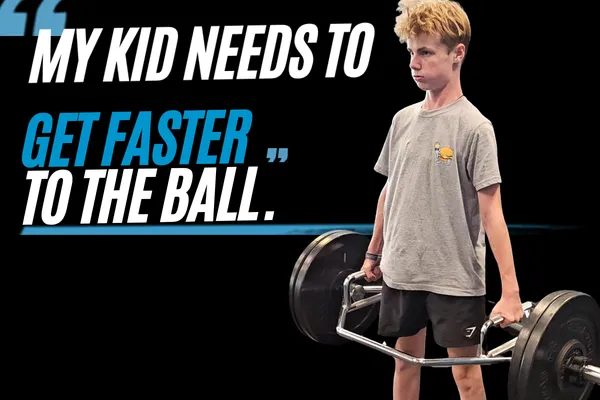
Want Your Athlete Faster to the Ball? Build Strength, Then Train Speed
“They need to get faster to the ball.”
We hear some version of that from parents in almost every sport. Soccer players need to close space. Baseball and softball players need a better first step. Lacrosse players need to create separation. Basketball players need to react and accelerate. Football players need to win the first few yards.
The temptation is to answer that problem with more cones, more ladders and more conditioning. Those tools can have a place, but first-step quickness is not one skill. It is the result of several physical qualities working together: force production, acceleration mechanics, coordination, reaction, deceleration and the ability to express strength quickly.
If we want an athlete to move faster, we should train those pieces instead of simply making them tired while they move around cones.
Acceleration is a strength-and-skill problem
The first few steps of a sprint require the athlete to apply force into the ground in useful directions. Stronger does not automatically mean faster, but an athlete with very little force-production capacity has a lower ceiling for acceleration.
A large systematic review and meta-analysis of resistance training in youth athletes found that resistance training produced moderate improvements in strength and vertical jump performance and smaller but meaningful improvements in sprint performance and agility. Another meta-analysis comparing traditional strength and power training in youth found that strength training was especially effective for improving lower-body strength and showed favorable effects on sprint performance. The authors suggested that strength provides a foundation for later power development.
That matches good coaching logic. Before chasing complicated “speed” drills, make sure the athlete can create and control force.
Strength alone is not enough
If all an athlete does is lift slowly, they are still missing the skill of sprinting. Speed needs to be practiced at speed.
Acceleration sessions should include actual short sprints with enough rest that the athlete can produce high-quality efforts. Ten yards performed with intent and full recovery can be more useful for acceleration than repeated tired sprints where mechanics fall apart.
Power training matters too. Jumps, bounds, throws and appropriate Olympic-lift derivatives can teach athletes to express force quickly. The key word is appropriate. A 12-year-old who is still learning how to land should not receive the exact power program of a physically mature 17-year-old.
Recent evidence in adolescent team-sport athletes continues to support both strength and plyometric training for improving acceleration, change of direction, jumping and sprint performance. Program variables and maturity matter, so this is another area where copying a social-media workout misses the point.
Change of direction is not just “agility ladder” speed
Getting to a ball often requires the athlete to stop, redirect and accelerate again. That means deceleration matters.
An athlete who cannot control their body when slowing down may take extra steps, stand too upright or lose time before they can reaccelerate. Strength training can support the eccentric strength needed to absorb force, while coached change-of-direction drills teach the athlete how to use that capacity.
Ladders can help with rhythm and foot coordination, but moving your feet quickly inside squares is not the same thing as producing enough force to redirect the whole body. Parents should be skeptical of any speed program that is ninety percent ladder drills and exhaustion.
What a useful speed session can look like
A youth speed session does not need to be complicated. It might include:
- A movement warm-up.
- Two or three acceleration drills that teach posture and projection.
- Several short sprints with full recovery.
- A jump or medicine-ball throw.
- One or two change-of-direction patterns.
- Strength work that supports the athlete’s needs.
The total amount depends on age, sport schedule and experience. During a competitive season, we may use less volume. During the off-season, there is usually more room to build.
What we do not want is turning every speed session into conditioning. If the athlete is breathing so hard that every sprint is slow, we are no longer training the same quality.
Confidence improves when athletes can feel the difference
There is also a psychological side to athletic development. Young athletes notice when they feel stronger. They notice when they can move a weight they could not move three months ago or when a sprint drill feels smoother. Research on resistance training and “the self” in youth found positive effects on measures such as resistance-training self-efficacy, physical self-worth and global self-worth, although the authors also noted that the quality of the evidence was mixed and more high-quality work is needed.
We should not promise that lifting weights will automatically make a shy athlete confident. But giving an athlete repeated experiences of learning, improving and succeeding can be powerful.
Build the athlete, not just the drill
Parents should also be patient with the timeline. Speed can improve, but young athletes are developing while they train. Growth spurts can temporarily change coordination. Sport practice can create fatigue. A faster 10-yard sprint in a testing session does not guarantee an athlete wins every ball in competition because anticipation and decision-making are sport skills too. Physical preparation raises the tools the athlete can use; the sport still teaches them when and where to use those tools.
If your child needs to get faster to the ball, the answer is rarely one magic exercise. It is a development process. Build strength. Practice acceleration. Train power. Teach deceleration and change of direction. Give them enough rest to actually move fast.
At BFP, our youth program is designed around those qualities rather than trying to make every session look impressive from the sideline. We recently added Tuesday and Thursday 6:15 PM sessions to give families another option around school and sport schedules. New athletes complete four Foundations sessions first so we can teach the basics and understand where they are starting.
Speed is a skill. Strength raises the athlete’s physical potential. Coaching connects the two.
Works Cited
- Lesinski, Melanie, Olaf Prieske, and Urs Granacher. “Effects and Dose-Response Relationships of Resistance Training on Physical Performance in Youth Athletes: A Systematic Review and Meta-Analysis.” British Journal of Sports Medicine, vol. 50, no. 13, 2016, pp. 781–795. https://doi.org/10.1136/bjsports-2015-095497. https://pubmed.ncbi.nlm.nih.gov/26851290/.
- Behm, David G., et al. “Effectiveness of Traditional Strength vs. Power Training on Muscle Strength, Power and Speed with Youth: A Systematic Review and Meta-Analysis.” Frontiers in Physiology, vol. 8, 2017, article 423. https://doi.org/10.3389/fphys.2017.00423. https://pubmed.ncbi.nlm.nih.gov/28713281/.
- Zhu, Xiaolin, et al. “Effects of Plyometric and Strength Training on the Physical Fitness Attributes of Male Adolescent Team Sports Athletes: A Systematic Review and Meta-Analysis.” BMC Sports Science, Medicine and Rehabilitation, vol. 17, 2025, article 363. https://doi.org/10.1186/s13102-025-01412-y. https://pubmed.ncbi.nlm.nih.gov/41361490/.
- Collins, H., et al. “The Effect of Resistance Training Interventions on ‘The Self’ in Youth: A Systematic Review and Meta-Analysis.” Sports Medicine - Open, vol. 5, 2019, article 29. https://pubmed.ncbi.nlm.nih.gov/31270635/.