WEIGHT LOSS & FITNESS BLOG
After an Injury, a Young Athlete Needs More Than Rest to Feel Ready Again
When a young athlete gets hurt, everyone wants the same thing: get them healthy and get them back to the sport they enjoy.
The medical and rehabilitation process comes first. A strength coach should not diagnose the injury, replace physical therapy or decide that an athlete is cleared to return. But once the appropriate healthcare professional has cleared the athlete for training, there is still often a gap between “allowed to participate” and “feels like themselves again.”
That gap can include strength, coordination, conditioning and confidence. A good return to training should respect all of those pieces.
Physical clearance and psychological readiness are not identical
Athletes can pass physical milestones and still hesitate when it is time to sprint, cut, land or absorb contact again. That does not mean they are weak-minded. Fear of reinjury is a real part of returning to sport.
A recent systematic review of psychological readiness after sports injury found that readiness measures were related to several return-to-sport outcomes, including return participation, quality-of-life measures, reinjury outcomes and post-return performance. Another systematic review on kinesiophobia in injured athletes found that fear of movement was associated with lower physical and mental outcomes and commonly overlapped with anxiety, low confidence and fear avoidance.
Those reviews include many adult athletes and different injury types, so we should be careful about applying one number to every teenager. The broader point is still important: an athlete can be medically cleared and still need progressive exposure before movement feels normal again.
Strength training can help rebuild what the injury interrupted
After a period of reduced activity, an athlete may have lost strength, tolerance to training or confidence in a specific movement. The solution is not automatically to throw them back into a full team workout and hope the sport rebuilds everything.
Supervised strength training has a strong evidence base for improving physical fitness in children and adolescents. Meta-analyses have shown improvements in strength, jumping, sprint performance and other physical qualities. That makes the weight room a useful place to rebuild capacity in a controlled environment.
The exercises depend on the injury and the athlete’s medical guidance. A lower-body injury may require carefully rebuilding squat, hinge, single-leg strength, landing and deceleration. An upper-body injury may require a different progression. None of this should be improvised around pain.
Progressions should create successful experiences
Confidence is easier to rebuild when the athlete repeatedly completes tasks they can handle.
Think about a basketball player returning from a knee injury. The progression may move from controlled strength work to landing drills, then to more dynamic jumps, deceleration, planned changes of direction and eventually reactive work. The athlete does not have to prove courage by skipping steps. Each step should provide information about physical readiness and help the athlete trust the movement again.
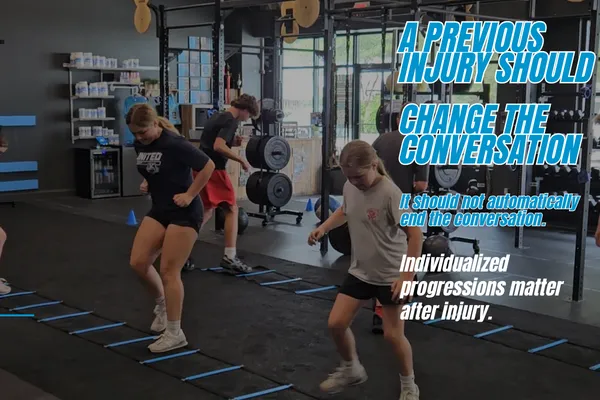
This is one reason individualization matters so much after an injury. Two athletes with the same diagnosis can have different timelines, symptoms, playing demands and confidence. A generic workout written for ten healthy athletes may not be the right environment for the first few weeks after clearance.
Do not promise to make an athlete injury-proof
Parents are understandably interested in “injury prevention.” We use the phrase injury resilience because it better reflects reality. No strength program can remove contact, awkward landings, collisions, growth spurts or every other factor involved in sports injuries.
Strength training can improve physical qualities that are useful for sport. Neuromuscular training programs that include strength, balance, landing and change-of-direction components have also been associated with lower injury rates in youth sport. That is valuable evidence, but it should never become a guarantee.
A previous injury is one risk factor among many, and it should influence how we coach the athlete. It should not become a reason to scare the athlete or parent into believing another injury is inevitable.
Communication matters
The best return-to-training situations usually have clear communication. Parents know what the doctor or therapist has cleared. The strength coach knows what restrictions remain. The athlete knows what to report. Everyone understands that pain, swelling or a meaningful change in symptoms may require stepping back and checking in with the medical provider.
For older youth athletes, we also want them learning how to communicate about their own bodies. “My knee feels different today” is useful information. So is “I am nervous about cutting to that side.” Teaching athletes to speak up is part of good coaching, not a sign that they are being difficult.
The goal is a confident return, not just a fast return
Parents can help by avoiding the constant question, ‘Does it hurt?’ before every session. Pain and symptoms absolutely need to be monitored, but the athlete also benefits from noticing what is going well. Ask what felt stronger, what movement felt more normal or what they were able to do this week that was difficult two weeks ago. Recovery should include awareness of problems without making the previous injury the athlete’s entire identity. The athlete also needs permission to have good days and bad days without treating either one as a final verdict on recovery.
Young athletes already feel pressure to get back. They do not need the weight room to add more.
At BFP, an athlete with a previous injury should have that history considered from the beginning. New youth athletes complete four Foundations sessions before joining regular youth small-group training, which gives us time to teach movements, learn their background and identify where we may need more information from a healthcare provider.
We recently added Tuesday and Thursday 6:15 PM youth sessions to make that ongoing training easier to fit around school and sports.
After an injury, the goal is not to pretend nothing happened. The goal is to rebuild capacity, expose the athlete to sport-relevant movement progressively and help them return feeling prepared for what comes next.
Works Cited
- Liu, Siqi, and Young-Eun Noh. “The Utility of Psychological Readiness Scales in Predicting Return to Sport: A Systematic Review.” BMC Psychology, vol. 13, 2025, article 1213. https://doi.org/10.1186/s40359-025-03378-5. https://pubmed.ncbi.nlm.nih.gov/41185037/.
- Baird, M. D., et al. “Kinesiophobia in Injured Athletes: A Systematic Review.” Journal of Functional Morphology and Kinesiology, vol. 9, no. 2, 2024, article 78. https://doi.org/10.3390/jfmk9020078. https://pubmed.ncbi.nlm.nih.gov/38651436/.
- Moreno-Torres, José M., et al. “Effects of Supervised Strength Training on Physical Fitness in Children and Adolescents: A Systematic Review and Meta-Analysis.” Journal of Functional Morphology and Kinesiology, vol. 10, no. 2, 2025, article 162. https://doi.org/10.3390/jfmk10020162. https://pubmed.ncbi.nlm.nih.gov/40407446/.
- Collins, H., et al. “The Effect of Resistance Training Interventions on ‘The Self’ in Youth: A Systematic Review and Meta-Analysis.” Sports Medicine - Open, vol. 5, 2019, article 29. https://pubmed.ncbi.nlm.nih.gov/31270635/.