
WEIGHT LOSS & FITNESS BLOG
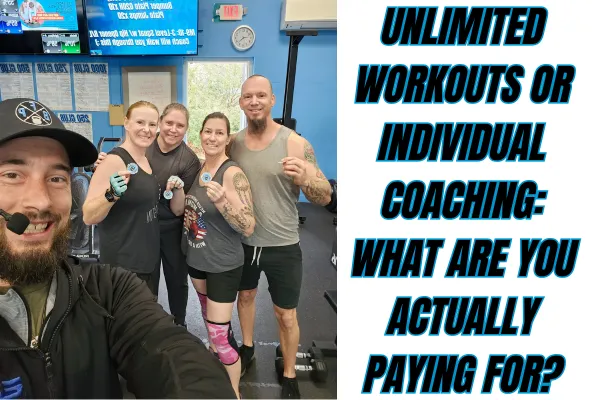
Unlimited Workouts or Individual Coaching: What Are You Actually Paying For?
Some people do very well in large, fast-moving classes. They already move confidently, understand how to adjust exercises, enjoy the pace and show up consistently without much outside accountability. Others need a coach who knows their history, watches their movement, chooses the right progression and changes the plan when pain, schedule or confidence becomes an issue. Those are different services, even when both take place in a gym.
Access and coaching are not the same product
Access gives you a place, a schedule and a workout. Coaching begins with the person. A coach should understand why you are training, what you have tried, where you have struggled and what limitations need to be considered. The workout then becomes one part of a broader process.
At BFP, that process can include an Initial Coaching Session, movement assessment, goal discussion, private Foundations sessions, individualized programming and ongoing adjustments. A person with a history of back pain may need a different hinge progression. A woman returning to strength training after years away may need more time learning the lifts. An experienced runner may need strength work that supports running instead of simply adding more fatigue.
Those differences are difficult to capture by counting how many classes appear on an app.
More workouts are useful only when the dose is right
Exercise has a dose. More can be helpful up to the point where recovery, quality and consistency begin to decline. A person who attends six hard classes every week may improve if that workload fits their experience and life. Another person may feel worn down, become increasingly sore, lose confidence or stop attending altogether.
A coach should help determine what is useful now. For many busy adults, two or three well-planned strength sessions provide a better starting point than unlimited access they feel pressured to use. The goal is not to win a contest for the most weekly check-ins. The goal is to build strength, improve fitness and continue long enough to benefit.
Research on resistance training supervision supports the value of direct coaching. In a randomized trial, participants completing the same resistance program achieved better improvements in several strength and muscle outcomes when the sessions were supervised. Supervision can affect exercise selection, technique, effort, load progression and the willingness to perform challenging work safely.
Individual coaching shows up when the plan needs to change
The value of coaching becomes most obvious on the imperfect days. Your knee is irritated. You slept poorly. You are returning after an illness. Work has created a stressful week. You are improving faster than expected and need more challenge. A generic workout can still be completed, but it may no longer be the best workout for you.
In private training, the session can be changed immediately around the person. In semi-private training, each client can follow an individualized program while the coach manages a small group. One person may squat while another uses a split squat or a supported variation. They are training in the same room without being forced into the same prescription.
This is also where accountability becomes more personal. Attendance is noticed. A missed week leads to a conversation. Goals are reviewed. Progress is measured in ways that include strength, movement quality, confidence, energy and the ability to live an active life—not only the number on the scale.
How to decide which option is worth the price
Price matters. Every household has a budget, and a fitness membership should make sense within it. The useful question is not simply, “How many workouts do I get?” Ask what kind of help you need to use those workouts well.
Do you want a coach to evaluate your starting point?
Do you have pain, a previous injury or a movement you are unsure about?
Do you need an individualized plan rather than one shared workout?
Do you tend to disappear from fitness programs after a few weeks?
Do you want someone to track progress and make adjustments?
Would a smaller environment help you feel more comfortable and confident?
If most answers are no, a larger unlimited class may fit you well. If several answers are yes, paying for coaching may provide more value than paying for access.
What BFP is built to provide
Breakaway Fitness & Performance is not trying to be the place with the most available classes in Hampstead or Surf City. We are building a coaching service. Group personal training remains a good fit for many members, but we also continue to build private and semi-private options because some people need more individual attention, flexibility or programming.
You should understand what you are buying before you commit. Unlimited access can be valuable. Individual coaching can also be valuable. The right choice depends on whether you mainly need a workout to attend or a coach to help you navigate the entire process.
Works Cited
Coleman, Max, et al. “Supervision during Resistance Training Positively Influences Muscular Adaptations in Resistance-Trained Individuals.” Journal of Sports Sciences, vol. 41, no. 12, 2023, pp. 1207–1217. https://pubmed.ncbi.nlm.nih.gov/37789670/.
Jansons, Paul S., Terry P. Haines, and Lisa O’Brien. “Interventions to Achieve Ongoing Exercise Adherence for Adults with Chronic Health Conditions Who Have Completed a Supervised Exercise Program: Systematic Review and Meta-Analysis.” Clinical Rehabilitation, vol. 31, no. 4, 2017, pp. 465–477. https://pubmed.ncbi.nlm.nih.gov/27301799/.
Hu, Chenxi, et al. “Effect of Resistance Circuit Training on Comprehensive Health Indicators in Older Adults: A Systematic Review and Meta-Analysis.” Scientific Reports, vol. 14, 2024, article 8823. https://pubmed.ncbi.nlm.nih.gov/38627495/.


Are you Ready to become
sTRONG - FIT - cONFIDENT?
Click the Button To Start Your Journey Today!!


