WEIGHT LOSS & FITNESS BLOG
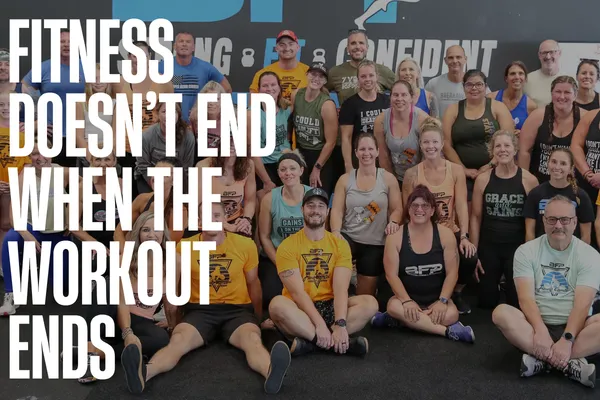
Fitness Does Not End When the Workout Ends
A good workout is important. It is also one hour of your day.
If you strength train three times per week, that is roughly three hours out of 168. Those sessions can create the stimulus to get stronger, maintain muscle, improve fitness and build confidence. What happens during the other 165 hours affects how well you recover, whether you have energy to train and how consistently you can repeat the process.
This is why we talk so much about nutrition, sleep, daily movement and accountability at BFP. Not because exercise is unimportant. Because exercise works better when the rest of your life supports it.
Strength training is the anchor
For adults in their 30s, 40s, 50s and beyond, strength training provides benefits that go well beyond the calories burned during a session. It can improve strength, preserve or build lean mass and support physical function.
But the training has to be progressive. If you lift the same weights for the same reps forever, your body has less reason to adapt. That is where coaching and programming matter. We want to know what you did last month and what you are ready to do next, not just whether you broke a sweat today.
Private and semi-private personal training make that level of progression easier to individualize. Group personal training can work well for people who need less individual programming but still want coaching and accountability. Different people need different levels of support.
Protein supports the work you do in the gym
Muscle is built and maintained through a combination of training and nutrition. A large systematic review and meta-analysis of randomized controlled trials found that increasing daily protein intake produced small additional gains in lean body mass in adults performing resistance exercise. The effects varied by age and total protein intake, but the overall message is useful: training provides the stimulus, and adequate protein supports adaptation.
That does not mean everyone needs a shake after every workout. It means your total diet should contain enough high-quality protein across the day. For many busy adults, breakfast is the meal where intake is lowest. That is why breakfast protein is the first weekly nutrition focus in our Fall Reset.
Eggs, Greek yogurt, cottage cheese, lean meat, a protein smoothie or leftovers can all work. The best choice is the one you can repeat.
Sleep changes what you bring to training
Sleep is another piece people tend to treat as optional until they are exhausted. You do not need perfect sleep to benefit from exercise, and parents with young kids sometimes have limited control over the night. But consistently short or disrupted sleep can affect mood, recovery, appetite and the quality of training.
Systematic-review evidence in athletes suggests that sleep interventions, especially extending sleep opportunity when sleep is inadequate, can improve some performance and recovery outcomes. Most of that research is in athletes rather than middle-aged recreational exercisers, so we should not oversell it. The practical lesson is simpler: recovery is not only what you do with a foam roller. Going to bed is part of the program.
Daily movement fills a different role than the workout
A strength session should not have to provide every bit of movement you get all day. Walking, taking the stairs, playing with your kids, working in the yard and simply spending less of the day sitting all contribute to your overall activity.
That is why our Fall Reset uses a daily step target. The point is not that 7,000 is a magical number for every person. The point is to create awareness and encourage regular movement outside formal workouts.
For someone who already trains but sits at a desk ten hours a day, adding walks can be a useful lever. For someone who has a physically demanding job, the conversation may be different. Coaching should account for the person, not worship one universal number.
Accountability connects the pieces
Most adults already know vegetables are good for them. They know sleep matters. They know water is better than living on coffee. Information is rarely the entire problem.
The harder part is turning knowledge into behavior when the week gets messy. Research on physical-activity behavior change has found that structured interventions can improve activity and that strategies such as action planning, prompts, instruction and graded tasks are associated with maintenance.
That is why we view accountability as more than someone asking whether you did the workout. It is looking at the pattern. Did you miss because the plan was unrealistic? Are you consistently under-eating before training? Are you trying to train hard five days per week while sleeping five hours? Do you need a private appointment on the calendar instead of hoping to make a class?
Those are coaching questions.
Build a system, not a collection of workouts or meal plans
You also do not need to improve every category at once. If training is consistent but breakfast is poor, work on breakfast. If food is solid but you average five hours of sleep because you stay up scrolling, start there. If workouts are good but the rest of the day is completely sedentary, add a walk. Trying to fix six habits in one Monday usually creates more friction than choosing the next useful behavior and practicing it until it fits.
If you want long-term results, think bigger than the session. Strength train. Eat enough protein. Get fiber from real foods. Sleep as consistently as you can. Move during the day. Build a schedule that survives busy weeks.
None of those habits needs to be perfect. They need to work together often enough that your health is not dependent on one heroic Monday.
Our 28-Day Fall Reset starts October 4 and is designed to help people practice that broader approach. The challenge uses simple daily habits and weekly nutrition focuses so you can see where your current routine is strong and where it needs work.
The workout is still important. We just do not pretend fitness stops when you walk out the door.
Works Cited
Tagliaferri, Sara, et al. “Systematic Review and Meta-Analysis of Protein Intake to Support Muscle Mass and Function in Healthy Adults.” Journal of Cachexia, Sarcopenia and Muscle, vol. 13, no. 2, 2022, pp. 795–810. https://doi.org/10.1002/jcsm.12922. https://pmc.ncbi.nlm.nih.gov/articles/PMC8978023/.
Fullagar, Hugh H. K., et al. “Sleep Interventions Designed to Improve Athletic Performance and Recovery: A Systematic Review of Current Approaches.” Sports Medicine, vol. 48, 2018, pp. 683–703. https://doi.org/10.1007/s40279-017-0832-x. https://pubmed.ncbi.nlm.nih.gov/29352373/.
Howlett, Neil, et al. “Are Physical Activity Interventions for Healthy Inactive Adults Effective in Promoting Behavior Change and Maintenance, and Which Behavior Change Techniques Are Effective? A Systematic Review and Meta-Analysis.” Translational Behavioral Medicine, vol. 9, no. 1, 2019, pp. 147–157. https://doi.org/10.1093/tbm/iby010. https://pubmed.ncbi.nlm.nih.gov/29506209/.