WEIGHT LOSS & FITNESS BLOG
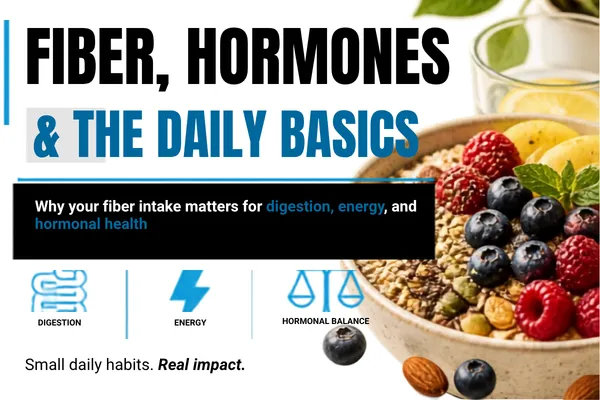
Fiber for Women: What the Research Says About Gut Health, Appetite, Blood Sugar and Hormones
Fiber might be one of the least glamorous nutrition topics on the internet. Protein gets more attention. Supplements get more attention. Hormone hacks get much more attention. Yet getting enough fiber is one of the habits that can improve the overall quality of a woman’s diet without requiring a complicated meal plan.
Fiber is found in plant foods such as vegetables, fruit, beans, lentils, whole grains, nuts and seeds. Different fibers behave differently in the body, so it is too simple to talk about fiber as if it is one single ingredient. Some fibers are more fermentable. Some form gels. Some mainly add bulk. That is one reason research findings on appetite, glucose and hormones are not identical across every study.
The practical takeaway is still straightforward: most women benefit from eating a variety of fiber-rich whole foods, and increasing intake gradually is usually a better approach than suddenly doubling it overnight.
Fiber does much more than help you stay regular
Digestive regularity is one benefit, but fiber-rich diets are also associated with better cardiometabolic health. Soluble fibers can slow digestion and affect post-meal glucose responses, while fermentable fibers provide substrate for gut bacteria. High-fiber foods also tend to bring vitamins, minerals and plant compounds along with them.
Fiber sometimes helps with fullness, but this is an area where social media oversimplifies the science. A systematic review on fiber, satiety and food intake found that the effects varied considerably depending on fiber type and study design. A later systematic review and meta-analysis of randomized controlled trials on soluble fiber also found that some types reduced subsequent energy intake more than others.
So “fiber always keeps you full for hours” is too broad. A bowl of berries, oats and chia may be very satisfying for one person, while another meal with the same grams of fiber may feel different. It is still reasonable to use higher-fiber foods as part of meals built around protein and minimally processed carbohydrates.
What about blood sugar?
Fiber can also change how quickly carbohydrate-containing meals are digested and absorbed. That does not mean every woman needs to fear blood-sugar spikes or remove carbohydrates. It means the structure of a meal matters.
A meal that includes protein, vegetables, a higher-fiber carbohydrate and some healthy fat tends to digest differently than drinking a large amount of sugar by itself. This is one reason the plate method is useful. It improves meal composition without requiring most people to weigh and track everything they eat.
For women who are trying to improve energy, appetite control or overall diet quality, adding beans to a bowl, berries to yogurt, vegetables to dinner or oats to breakfast is usually a more useful starting point than searching for a supplement that promises to “fix” metabolism.
Does fiber balance hormones?
This is where we need to be careful. You will see claims that fiber “balances estrogen” or “detoxes hormones.” Those phrases make the science sound much more certain than it is.
There is evidence that dietary fiber can influence circulating estrogen under some conditions. An older controlled study in premenopausal women increased fiber intake from about 15 to 30 grams per day using different brans. The wheat-bran group had reductions in estrone and estradiol, while oat and corn bran did not produce the same change. A larger 12-month randomized trial tested a broader low-fat, higher-fiber dietary pattern in premenopausal women and evaluated sex hormones over time. Observational work has also found associations between fiber intake and estrogen-related measures in some groups.
But the findings are not universal. Other studies have found no independent association between fiber intake and sex-steroid hormone levels. Different fiber sources, total diet, body composition, menstrual status and study design all matter.
That is why I would not tell a woman to eat thirty grams of fiber because it will “balance her hormones.” We can say that fiber is an important part of a high-quality diet, that there are plausible and observed relationships between fiber and estrogen metabolism, and that the hormone story is more nuanced than an Instagram graphic.
How to move toward 25–30 grams without making your stomach miserable
If you currently eat very little fiber, going from ten grams to thirty overnight can leave you bloated and uncomfortable. Increase it gradually and make sure fluid intake rises with it.
A simple day might look like this:
- Breakfast: Greek yogurt, berries and chia seeds.
- Lunch: chicken or tuna bowl with vegetables and beans.
- Snack: an apple with nuts.
- Dinner: lean protein, a large serving of vegetables and a potato, whole grain or lentils.
You do not need all of those foods every day. Variety is useful. Beans and lentils are excellent. Fruit counts. Frozen vegetables count. Whole-grain bread can count. Chia and flax can be convenient additions.
During Week 3 of our 28-Day Fall Reset, fiber is the main nutrition focus. The goal is not perfection. It is helping people notice how much they are getting, build a few meals that make the target easier and learn which foods work well for their digestion.
Start with food quality, then get more specific if you need to
Nutrition advice gets noisy quickly, especially for women in their 30s, 40s and 50s. Hormones become an easy explanation for every symptom and every stalled goal. Sometimes the basics are less exciting but more useful.
Eat enough protein. Eat fruits and vegetables. Include higher-fiber carbohydrates. Get some healthy fats. Strength train. Sleep as consistently as your life allows. Then, if you have symptoms that require medical evaluation, work with the appropriate healthcare provider rather than assuming a nutrition hack can diagnose or treat them.
Fiber deserves a place in that foundation. Not because it is a hormone miracle, but because it supports a lot of the basic health outcomes we care about and makes a balanced diet easier to build.
Works Cited
- Clark, Michelle J., and Joanne L. Slavin. “The Effect of Fiber on Satiety and Food Intake: A Systematic Review.” Journal of the American College of Nutrition, vol. 32, no. 3, 2013, pp. 200–211. https://doi.org/10.1080/07315724.2013.791194. https://pubmed.ncbi.nlm.nih.gov/23885994/.
- Wanders, A. J., et al. “Effects of Dietary Fibre on Subjective Appetite, Energy Intake and Body Weight: A Systematic Review of Randomized Controlled Trials.” Obesity Reviews, vol. 12, no. 9, 2011, pp. 724–739. https://pubmed.ncbi.nlm.nih.gov/21676152/.
- Rose, D. P., et al. “High-Fiber Diet Reduces Serum Estrogen Concentrations in Premenopausal Women.” American Journal of Clinical Nutrition, vol. 54, no. 3, 1991, pp. 520–525. https://doi.org/10.1093/ajcn/54.3.520. https://pubmed.ncbi.nlm.nih.gov/1652197/.
- Gaskins, Audrey J., et al. “Effect of Daily Fiber Intake on Reproductive Function: The BioCycle Study.” American Journal of Clinical Nutrition, vol. 90, no. 4, 2009, pp. 1061–1069. https://doi.org/10.3945/ajcn.2009.27990. https://pubmed.ncbi.nlm.nih.gov/19692496/.
- Cui, Xiaohui, et al. “Dietary Fat, Fiber, and Carbohydrate Intake and Endogenous Hormone Levels in Premenopausal Women.” Hormones and Cancer, vol. 1, no. 5, 2010, pp. 265–276. https://doi.org/10.1007/s12672-010-0050-6. https://pubmed.ncbi.nlm.nih.gov/21761370/.