WEIGHT LOSS & FITNESS BLOG
Strength Training After 55: You May Need Less Than You Think to Make Progress
One of the biggest mistakes adults make with strength training after 55 is assuming it has to be extreme to work.
They picture heavy barbells, five-day programs, soreness that lasts all week or workouts designed for people half their age. If that is the only version of strength training you have seen, it is easy to decide it is not for you.
But the research paints a much more encouraging picture.
Older adults can improve strength, physical function and muscle with resistance training, and meaningful progress does not always require a large training volume.
Strength becomes more important as we age
Muscle mass gets a lot of attention, but strength and power are especially important for daily function. Being able to stand from a chair, climb stairs, carry groceries, catch yourself when you lose balance and get off the floor all depend on your ability to produce force.
Resistance training is one of the most direct ways to train that ability.
A 2024 systematic review and network meta-analysis looked at 151 randomized trials involving more than 6,000 older adults. The researchers compared lower-, moderate- and higher-volume resistance-training programs. Lower-volume training produced meaningful improvements in physical-function measures, lean body mass and muscle size. Moderate and higher volumes tended to be better when the goal was maximizing lower-body strength.
That distinction is useful.
You do not need the maximum possible dose to get a meaningful health benefit. More training may be appropriate when goals become more ambitious, but a lower-volume plan can still move you forward.
Starting small is often the smart move
If someone has not strength trained in years, there is no reason to begin with the workload of an experienced lifter.
A good starting program might include two or three sessions per week with a handful of movements that cover the major muscle groups. Early progress often comes from learning the exercises, becoming more comfortable with resistance and gradually increasing what you can do.
That may include:
- Squat variations to a box or bench
- Deadlift or hinge variations
- Rows and pulldowns
- Pressing exercises appropriate for the shoulders
- Step-ups or split-squat variations
- Loaded carries and balance work
The specific exercise does not have to look impressive. It has to be appropriate and progressively challenging.
This is where adults sometimes underestimate themselves. They assume “safe” training must stay very light forever. The better approach is to start at an appropriate level and then build. The body needs enough challenge to adapt.
Muscle can still respond later in life
Age changes the training process, but it does not eliminate the ability to adapt.
A 2024 systematic review and meta-analysis of randomized trials in adults 65 and older found that resistance training increased muscle size at both whole-muscle and muscle-fiber levels. Training duration appeared to influence some of those changes.
That is an important reminder for anyone who thinks they “missed their chance.”
The body can still respond to training. The program may need more attention to recovery, medical history, joint tolerance and previous experience, but strength training remains productive.
Consistency matters more than trying to make up for lost time in the first month.
Supervision can be valuable when confidence is low
Many adults over 55 are not avoiding strength training because they dislike the idea of being stronger. They are avoiding it because they are unsure what they should do.
They may have an old knee injury, osteoporosis concerns, a shoulder that has bothered them for years or simply no experience using weights.
That is where good coaching can make the gym feel much more manageable.
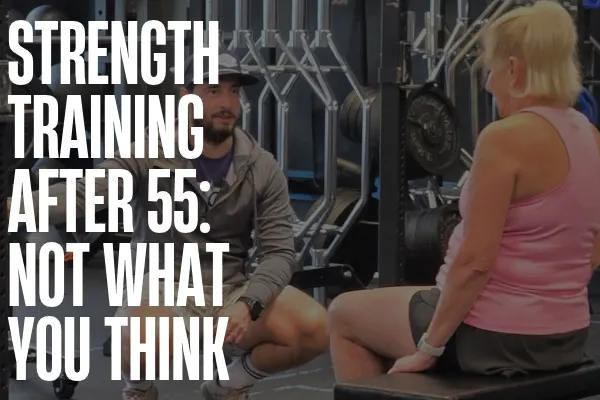
A 2024 systematic review and meta-analysis comparing supervised and unsupervised exercise in older adults found that supervised exercise produced better outcomes in several physical-function measures. Not every outcome favored supervision and unsupervised exercise can certainly work, but direct coaching can help with exercise selection, progression and confidence.
At BFP, someone who needs more individual attention can begin with private training. Others may be a good fit for semi-private training, where they follow an individualized program in a small coaching environment. Adults who are ready for a larger setting can use group personal training.
There is no rule that says everyone over 55 belongs in the same “senior” workout.
You are training for the next decade, not the next Tuesday
The biggest reason to strength train after 55 is not to win a workout.
It is to keep options open.
You want to be able to travel. Pick up a grandchild. Work in the yard. Play golf. Walk up a hill without wondering whether your legs can handle it. Recover better when life demands more from you.
Those abilities are easier to preserve than to rebuild after they have been lost.
So start with a dose you can repeat. Two well-coached sessions may be enough to create momentum. If you enjoy training and recover well, you can do more. If your goal becomes maximizing strength, we can increase the dose.
You do not need to wait until you feel old enough to “need” strength training.
Strength is one of the things that can help you stay capable as you get older.
And you probably need less than you think to begin.
Works Cited
- Radaelli, Régis, et al. “Effects of Resistance Training Volume on Physical Function, Lean Body Mass and Lower-Body Muscle Hypertrophy and Strength in Older Adults: A Systematic Review and Network Meta-Analysis of 151 Randomised Trials.” Sports Medicine, 2024. https://pubmed.ncbi.nlm.nih.gov/39405023/.
- Gómez-Redondo, Paola, et al. “Supervised Versus Unsupervised Exercise for the Improvement of Physical Function and Well-Being Outcomes in Older Adults: A Systematic Review and Meta-Analysis of Randomized Controlled Trials.” Sports Medicine, vol. 54, no. 7, 2024, pp. 1877–1906. https://doi.org/10.1007/s40279-024-02024-1. https://pubmed.ncbi.nlm.nih.gov/38647999/.
- Marzetti, Emanuele, et al. “Lower Extremity Muscle Hypertrophy in Response to Resistance Training in Older Adults: Systematic Review, Meta-Analysis, and Meta-Regression of Randomized Controlled Trials.” Experimental Gerontology, 2024, article 112639. https://doi.org/10.1016/j.exger.2024.112639. https://pubmed.ncbi.nlm.nih.gov/39579806/.
Frequently Asked Questions
Is it too late to start strength training after 55?
No. Adults can improve strength and physical function well beyond age 55. The program should start at an appropriate level and progress based on the person's ability, training history, and health considerations.
How many days per week should adults over 55 strength train?
Two sessions per week is a practical starting point for many adults and can produce meaningful improvements when training is consistent. Some people may train more often depending on their goals and recovery.
Do older adults need heavy weights to get stronger?
Not always. Resistance needs to be challenging enough to create an adaptation, but there is more than one effective loading strategy. Exercise choice, effort, progression, and consistency are all important.
Can strength training help adults stay independent as they age?
Strength training can improve strength, muscle mass, and physical function, which are important for everyday tasks such as getting up from a chair, climbing stairs, carrying objects, and staying active.
Does BFP offer strength training for adults over 55 in Hampstead?
Yes. BFP offers private, semi-private, and coached training options for adults over 55. Training can be adjusted for experience, confidence, mobility, previous injuries, and individual goals.